

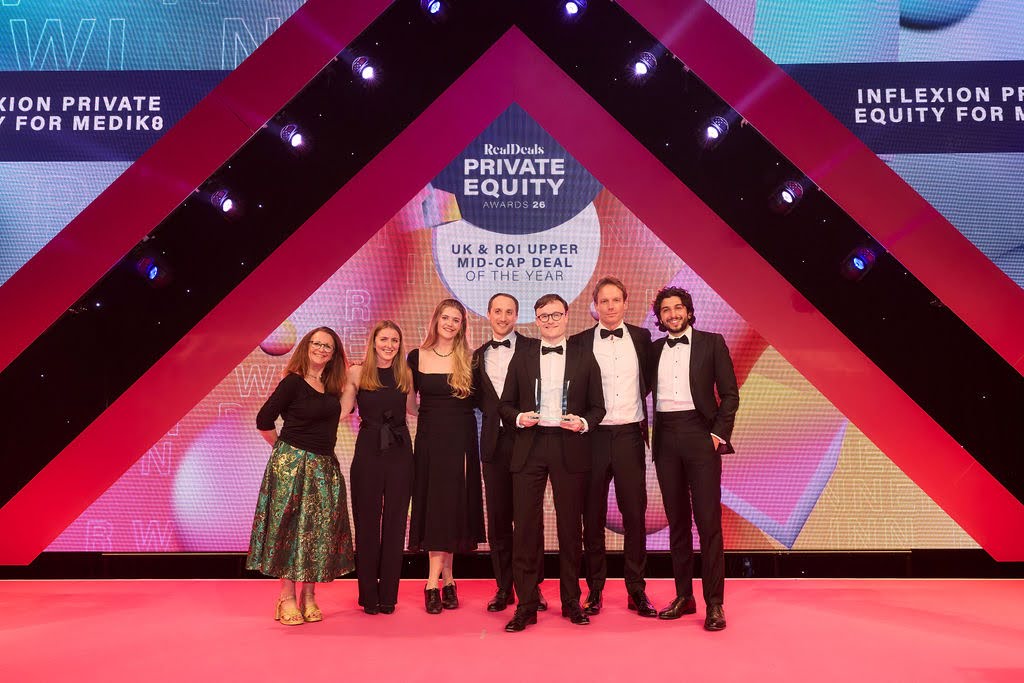
Tom Pemberton, Partner, Head of the Enterprise Fund and Head of Consumer at Inflexion, joins Jack Lane, Managing Director at Finatal, to discuss the journey behind Medik8’s award-winning sale to L’Oréal.
Finatal was headline sponsor of the Real Deals Private Equity Awards 2026, where the transaction was named Upper Mid-Market Deal of the Year.
Medik8 is one of the most talked-about consumer exits of the last cycle. In April 2025 L’Oréal acquired the British anti-ageing skincare brand from Inflexion in a deal that picked up Real Deals’ Upper Mid-Market Deal of the Year. Behind it sits a four-year hold, a three-year courtship before that, and a partnership between a founder-chemist and a private equity house that decided the best way to win the deal was not to chase it.
Tom Pemberton heads Inflexion’s consumer team. He sat down with us to walk through what actually happened, from the first coffee at a conference to a strategic exit that kept the culture, the CEO, the CFO, and a minority stake for Inflexion intact.
You’ve been at Inflexion for a decade. Set the scene on what the consumer team actually invests in.
Consumer for us is quite focused. We invest only in digitally-native brands and consumer technology. Within brands, we really focus on the high-growth categories where we see strong international opportunities. Pets, health and wellness, and beauty are where we double down. We’ll selectively look at enthusiast categories and sport. On the consumer tech side, we spend our time in e-commerce, marketplaces, and classifieds. Equity cheques from about €50m up to €500m, minority or majority, across Europe.
Does the team split by sub-sector?
Yes. We run quite narrow focus areas, what we call campaigns and sub-category deep dives. Each team member has a couple of areas they own, based on prior experience or board work. And we’re always adding new categories each year.
Medik8 sat inside a sub-sector you’d been deep-diving. How did it come to the table?
We’d been doing a lot of work on beauty and then deep-diving into sub-sectors. Anti-ageing skincare kept coming out as a really interesting category. We spent three or four years getting to know people in the market. We were fortunate enough to meet Elliot, the founder of Medik8, at a conference and built the relationship organically from there.
Elliot Isaacs looks like the antithesis of the modern influencer-led beauty founder. What drew you to him?
He’s an amazing individual. Elliot is a chemist and scientist by training. His family had a pharmacy and he grew up tinkering in the back of it, so there’s a real product heritage. He and his brother co-founded the business. What we loved was that everything was product-led and product-first. Bring the best ingredients and the best-quality products to market, and the rest takes care of itself.
By the time we met him, the business had been going for over ten years. It wasn’t a flash-in-the-pan influencer brand. It had built genuine credibility through the professional channel with dermatologists and key opinion leaders recommending the product. And it was fully vertically integrated, all the R&D done in-house.
Three years is a long courtship. How much of that time is shaping your entrance versus just helping a founder on their way?
A bit of everything. For founders and entrepreneurs, bringing on a partner is one of the biggest decisions they’ll ever make. You need time together to know you work well together and that you’re aligned on the approach to growing the business.
Particularly in consumer, there’s an easy option and a harder, long-term option. In the age of digital and social media, you can grow the top line very aggressively with marketing spend. Elliot didn’t want that. He wanted to build a long-term business, invest in it, and build something genuinely valuable over five to ten years. That three-year period was really us aligning on strategy: expansion in the US, building out the team, focusing on DTC. And retaining the culture and the people he’d invested in over many years, putting them in a position to have real equity.
Timelines: founded in 2009, exit to L’Oréal in 2025. Walk me through what you saw on day one when you signed.
It was a really well-built, well-invested business when we went in in 2021. Product-led. When we referenced it in the market, everyone said the same thing, the quality of the ingredients, the quality of the products, and the efficacy were exceptional. Which in skincare is the most important thing.
Great foundation, strong team, already internationalised, invested in manufacturing capacity. Where we aligned was on three things we needed to double down on: DTC and digital, access to the US, and building out the talent bench. On the last one, we effectively added a layer of C-suite on top of a very strong team, CEO, COO, chief customer officer, US GM, head of digital, head of sustainability. And we also invested heavily in a new innovation centre to support the growth we were about to go on.
How much did the three-year build-up help you move faster on the people build once the deal closed?
Hugely. Elliot and the team had already met a lot of our value acceleration team. In the first two weeks after signing, we sat down with them and a chair we’d already lined up, and worked out what the optimal structure should look like over three to four years. Because we’d done that homework, we could accelerate hiring and capability build, particularly across DTC and the US, from day one. Normally there’s a bit of tension between founder-owner and incoming investor. With us and Elliot it was seamless.
Were there any early misalignments?
None, honestly. It was one of those investments you’d love them all to be like. Brilliant founder, brilliant exec team, well-invested business, huge market opportunity. We’d aligned early on where we could add value. Elliot kept a strong stake, we brought the broader team in on sweet equity, and they made a great return given the outcome. It was one of those deals you wish you could see every time.
You’ve been nominated for Deal of the Year four times and won twice, you might have something to do with it. Where were the pivotal moments in Medik8’s value creation?
First and foremost, in all our successful investments, it’s about the people. Getting the right talent in early. With Medik8 we had a brilliant board, a fantastic chair in Chris Kohler with real experience internationalising luxury brands, and a fantastic CEO, who joined us from L’Oréal. The C-suite build beyond that, the COO, the CCO, the sustainability team, was exceptional.
One of the real pivotal hires was in the US. It’s a tough market to hire in from the UK. We invested really early, built the team in New York before we had any sales, and that team then accelerated the growth in the US enormously. Consistent thread: get the right talent in as early as possible.
“Professionalisation” is often used unfairly for a deal like this. How did the existing team level up alongside the new hires?
A few ways. Bringing in people who’d been at larger organisations was one element, the CEO being ex L’Oréal is a good example. But the biggest thing is that the people already in the business were hugely ambitious and hugely capable. Lilia, the CFO, is phenomenal. She was at Medik8 for many years before we invested, went through our hold with us, and has now gone through the L’Oréal deal. She continues to shoot the lights out. There were a lot of people from the very beginning who are still there today.
At what point do you start thinking exit? And what levers do you pull to angle towards trade?
We do a lot of pre-investment work on what the business needs to look like at exit, the attributes, the KPIs a strategic will look for. That’s often a big focus at investment committee. In this environment, where DPI is king, that discipline has put us in a strong position. We’ve had some phenomenal exits to strategics across sectors, and even more pronounced in consumer.
The approach is: build something great and long-lasting in a sub-sector where there are a large number of strategic acquirers. You should get interest. With Medik8 we knew there’d be PE interest, great margins, great financial profile, still lots of runway. But you rarely get a process with more than a handful of live strategics, because every strategic has different internal dynamics, funding cycles, other things going on. They come in and out of windows. You’ve got to work out when the optimum window is.
The real takeaway: you’ve got to be thinking about exit before you sign the cheque. Build the relationships with the PE funds and the strategics years before. Understand what they’re looking for. Share numbers when appropriate. Get them excited about where you’re taking the business.
Does that help you control the narrative on exit?
We will always give people access if they’re genuine and relevant, and give them the opportunity to move quickly. It self-selects. Those with conviction run harder, do the work earlier, get into position, and typically because of all of that, they put the best price on the table.
We’re a private equity house, but ultimately the management team need to be comfortable with the new buyer. You have to socialise that too, make sure everyone’s pointing in the same direction. We probably do that a bit earlier than some other funds.
Balancing an exit process with business-as-usual is one of the hardest things in PE. How do you do it?
It comes down to the depth of the team. We hire CEOs and senior execs who’ve run bigger businesses and ideally been through a process before. We’re not big on running extremely wide processes and meeting every single person under the sun, that’s why we do the work up front. We try to condense the intensity of an exit because we know who the real runners and riders are early.
The other piece is having depth below the C-suite. That’s ultimately why Medik8 traded so exceptionally, it actually outperformed budget through the process, because the layer below the CEO and CFO was strong while they spent more time on the deal itself.
And after the deal, how much do you play a part in integration to protect what Elliot built?
A big part of it. L’Oréal have done hundreds of deals over the years, some integrated, some kept separate. With Medik8 we still own a minority stake. It’s kept separate. Elliot still sits on the board and is heavily involved. Same management team. The CEO still runs it, Lilia stayed as CFO. It’s as good as it can be for a strategic deal.
L’Oréal have been great in that regard. It’s in their DNA to integrate businesses appropriately over time while keeping the ethos, the culture, and the entrepreneurial dynamics that made the business great in the first place.
Would a more aggressive absorption approach have changed your exit decision?
For sure. We had lots of interest and were always going to stay involved. There were other options, including non-PE alternatives. The biggest thing was we wanted to stay in, Elliot wanted to stay in, and we wanted to keep the brand separate so the culture was retained and the management team could benefit from further growth. There’s a structure set up to give them additional equity over the business plan. We wouldn’t have done the deal if we were worried about any of that being lost.
Advice to founders thinking about strategics versus PE in today’s market?
Spend time with them. A couple of years getting to know them. Understand the strategy, how you fit into the product portfolio, who the key people are internally that you need to bring on the journey. The opportunity with strategics is huge, they’re sitting on a lot of cash, but they take a lot more time to get a deal done than a PE fund does.
PE in good consumer categories will be there, arguably more so now than 12 or 24 months ago. So you’ll always have the option. But if you want the real knockout strategic bid, spend the time getting to understand the top three or four strategics, build the relationship, and hit the window where it makes sense for several of them to be really interested.
How does the wider Inflexion structure feed into how the consumer team operates?
Huge. We work as a very flat partner group. Constantly sharing. Lots of teaching. We have an investment committee and a realisation committee, the realisation committee focuses purely on exits and positioning our businesses for exit. That’s not something that starts three years in; we’re doing it from day one. Successful deals like Medik8 get a teach-through to the whole investment team. So do the less successful ones, often the deals that don’t go as well are where you learn the most.
How do those learnings show up in the current portfolio, Nodor, Blue Light Card?
It’s huge. In Nodor there’s a DTC strategy, a US strategy, a big talent strategy, a lot of the parts of the investment thesis that worked for Medik8 apply. Blue Light Card, same story: we hired and managed a founder transition, brought in a brilliant team, focused heavily on technology and product. We take the best learnings from each investment. We’ve been going 26 years and done over 120 deals, there’s always something to take from the successes, and just as much from the challenges.
Zooming out, everyone’s talking about private equity being in chaos. Your view?
It’s an interesting landscape, but it always is. Ups and downs are part of the industry. Our strategy has stood the test of time: be very deeply sub-sector focused, know your lane, know where you can genuinely add value. We have a team of over 20 people focused just on value acceleration.
A lot of what we do is backing entrepreneurs. They might be first-time PE, second-time PE, but it’s finding the great entrepreneurs who want a backer who can support them across multiple angles. And then it’s getting the right people into the business. If you’ve got your strategy right, there are still lots of pockets of growth in Europe. It’s competitive. You’ve got to do the work, particularly on origination, building those relationships as early as we did with Medik8, so you’re the natural partner when the moment comes.
The prevailing theme is hard work. Tom, thank you.
Thanks, appreciate it.
This interview was lightly edited for length and clarity. Finatal was the headline sponsor of the Real Deals Private Equity Awards 2025, where Inflexion won Upper Mid-Market Deal of the Year for the sale of Medik8 to L’Oréal.